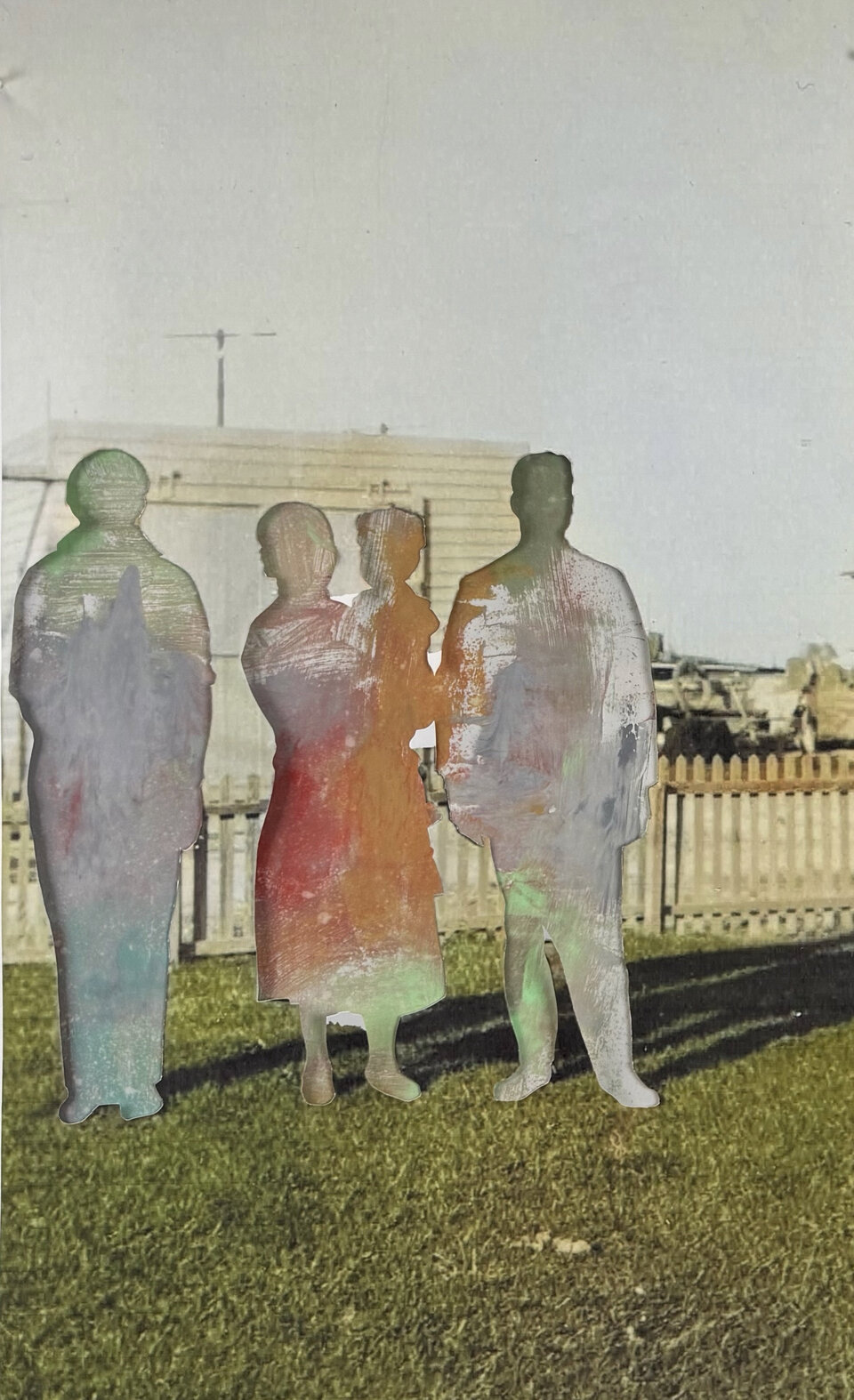
Elizabeth Burden, Dreaming Into Existence II, 2024, mixed media on paper and canvas.
Elsewhere / The Prairie Was Ours
Lower-level Gallery
August 25–December 19, 2026
The prairie is not just a place—it is a presence. A rhizome not just beneath our feet but also within our psyches. Just as native prairie grasses grow from entangled networks underground, the stories here emerge from roots that are collective, dispersed, and resilient.
Elsewhere / The Prairie Was Ours invites us to understand Nyi Brathge (Nebraska) not only through geography but through relation. It asks: What lives beneath the visible? What networks of kinship, memory, and survival shape this land—and those shaped by it?
This exhibition brings together the work of three artists—Elizabeth Burden, Willa Ahlschwede, and Marci Sue Black—descendants of formerly enslaved Black American, immigrant European American, and Indigenous communities shaped by prairie life. Their works use image, sound, artifact, and gesture to trace and unsettle memory. They invite us to remember not through monuments of stone, but through echoes in the soil and whispers in the archive.
Marci Sue Black is a member of the Jiwere-Nutachi (Otoe-Missouria) tribe of Oklahoma and an Ioway descendant. Being born and raised in her tribal community has shaped and influenced everything she does including her multidisciplinary art and traditional Indigenous mediums such as sewing regalia, beading, and making jewelry, leather handbags, and belts.
Willa Ahlschwede is an educator and curator living in Tucson, Arizona, unceded homelands of the Tohono O’odham. Growing up in Omaha, she is a fifth-generation Nebraskan, where her family received land in Saline County in 1872 as part of the Homestead Act. As an educator in museums and experiential environmental education, she is interested in how we build meaning and possibility through shared experiences with art and the world around us.
Elizabeth Burden is an artist who engages in artistic archivy, blending multidisciplinary studio work with social practice to reflect on the past/present/future. She was born and raised in Lincoln; as the great-granddaughter of the first Black homesteaders (Henry and Mary Burden), she is a third-generation Nebraskan, now living in the Southwest. Burden is the Great Plains Art Museum’s 2026 Elizabeth Rubendall Artist in Residence. Visit the artist during her residency at the museum from Sept. 1 to 12. Learn more about the residency and scheduled events.

Madeline Cass, salt marsh grass at Arbor Lake, 2018, archival pigment print. Courtesy of the artist.
how lonely, to be a marsh
Lower-level Gallery
January 19–May 8, 2027
how lonely, to be a marsh is an expanded exhibition of an ongoing project by Madeline Cass originally commissioned by the Platte Basin Timelapse project at the University of Nebraska–Lincoln. Bringing together new photographic works made since the project’s 2019 publication with select natural history specimens and archival materials, the exhibition explores wetlands and museum collections as sites of memory, preservation, and loss. Through photography, ambient landscape audio, video, and objects, the exhibition invites sustained looking and listening, asking how ecological grief is held, witnessed, and made visible within institutional spaces.