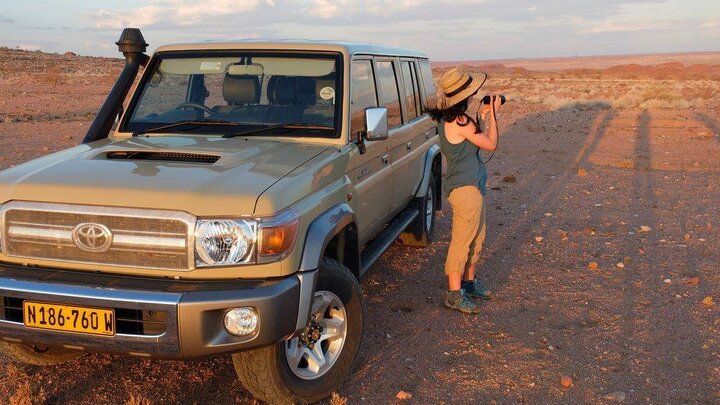
I had the opportunity to return to Namibia to see what arguably is the world’s most successful wildlife-renewal program. I traveled with some Montana folks affiliated with the American Prairie Foundation (APF) and one Washington, D.C.-based World Wildlife Fund (WWF) official; we were in Namibia from June 17 to 29, 2008.
Namibia has made great strides in conservation, as evident from an inspection tour taken in June, 2008, primarily because it has developed innovative models for private and communal conservancies that complement management of their public lands. The conservancies especially supplement the role of the national parks. We had the opportunity to visit two different types of conservancies, and their differences highlight the different strategies being followed by the Grassland Foundation in Nebraska and by APF in Montana. Both the Grassland Foundation and APF are being assisted by WWF.
Here is the difference in the two strategies: In Nebraska, the Grassland Foundation is working with ranchers as partners, in a program where ranchers change the use of their own land to promote conservation and bio-diversity; the ranchers make money from eco-tourism and may continue to run cattle on their land as well. In Montana, APF is buying ranches and creating a private reserve which it owns; it removes the cattle and internal fencing, and will manage its land to preserve (or bring back) the original bio-diversity. Each strategy can be a winner, as we saw in Namibia.
The Waterberg Conservancy illustrates the first strategy. Waterberg is a private voluntary association of eleven members – ten cattle farms and the Cheetah Conservation Fund, which owns land and has some farming operations. The members each continue to own their own farms and run their livestock, hunting, and eco-tourism operations separately. The Conservancy jointly manages the wildlife on the combined property of all the members; for example, one joint function is carefully monitoring animal populations. CCF organizes an annual 24-hour full-moon game count, using over 90 volunteers who count game around 45 waterholes on conservancy farms. On the basis of its monitoring, the Conservancy sets sustainable quotas for huntable species, but perhaps more importantly, it is able to maintain a careful inventory of the health of all its species.
The Waterberg Conservancy now includes about 370,000 acres. It provides habitat for amazing populations of kudu, warthog, leopard, eland, hartebeest, baboon, over 240 species of birds, and many other animals. CCF is the world center for cheetah research, education, and fieldwork. Much of its educational work is directed to cattle and goat farmers, to teach them techniques that allow them to co-exist with (rather than kill) predators. One highly successful program is its breeding, training, and supplying farmers with special guard dogs – the dogs chase away the cheetah (who should be stalking wildlife rather than livestock, anyway), the cheetah survive in the wild, and the farmer loses no livestock – one of several non-lethal predator management strategies that CCF has developed.
NamibRand (meaning “edge of the Namib desert”) has followed the second strategy. It exists because of the vision and long-term commitment of its founder, Albi Brückner. Brückner is a German immigrant who started a farm-machinery business in the capital of Windhoek in the 1940s. In the 1980s he acquired, more or less on a whim, a cattle ranch (or “farm” as they call them) in the southeast of the country. According to Albi, this was extremely poor cattle country, too dry and devoid of grass, but nonetheless it had been fenced and overgrazed and the farmers were just trying to hang on until better times arrived. After some years of floundering around, not clear on what he should do with his farm, he finally decided that the land would be much better being used as it had been before the white farmers arrived – namely, for wildlife.
Over the succeeding dozen or years, Brückner, working with several partners, bought out twelve more farms and assembled some 440,000 acres. It is a physically spectacular landscape. The reserve provides a vital link for a great flow of wildlife that graze in the national park to the east during the rainy season, then migrate across NamibRand to the mountains in the west when the park forage runs out. The reserve has become an important site for conservation, education, research, and incredible wildlife viewing. The reserve now finances itself on the revenues derived from entry fees it charges to visitors and on payments from concessionaires who run the several luxury camps on the reserve.
Two different strategies for private nature reserves. Both can be successful conservators of nature, as is so impressively demonstrated by Waterberg and NamibRand.


