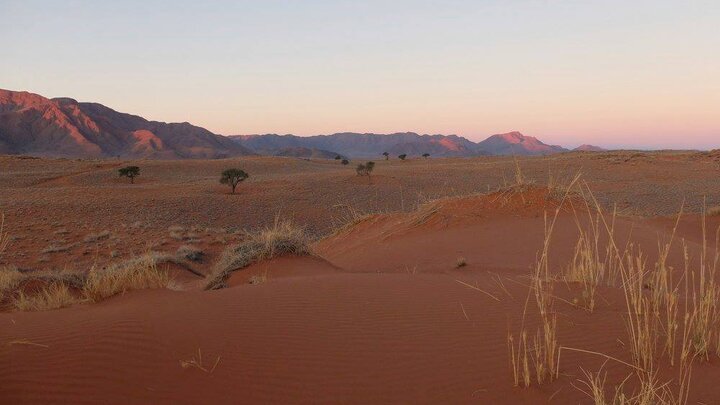
Returning to a place where one has had a memorable, even life-changing experience has a spotty history. It worked out f ine for MacArthur and Odysseus, but for Napoleon returning from Elba and Julius Caesar returning to Rome, not so much. So it was with considerable trepidation that I joined up for a second trip to Namibia (Africa), site of perhaps the world’s most successful wildlife renewal program.
Our group included three Montana folks affiliated with the American Prairie Foundation, one Washington, D.C.-based WWF official, a woman representing the Ft. Berthold Native Americans, and me. We were in Namibia from June 17 to 29, 2008.
I should not have worried. The accomplishments of the Namibians are even more impressive the second time around, when the naivete of the first-time traveler is replaced by a more skeptical eye. Yes, there was some repetition, but renewing ties with friends and re-seeing their conservation accomplishments more than compensated.
Namibia made a profound change in how it governs wildlife, by granting to landowners the right to own the wildlife (except rhino) on their land, and by encouraging (sometimes requiring) the establishment of nature conservancies, that is, multi-farmer or communal associations to manage their wildlife jointly. These new rights were first granted to white farmers by the apartheid regime in 1967 and extended to communal (tribal) lands by the black-majority government in 1996.
The Namibian farmer got a new source of income, in trophy-hunting fees and increasingly in revenues from wildlife viewing, photographic safaris, and lodges. Namibian farms used to be advertised for sale as “game free,” but now, instead of being pests and competitors with livestock for valuable grass, wildlife has become an asset to farmers. Poaching has been nearly eliminated (wildlife is too valuable in attracting tourists to poach), and animal numbers have soared. Namibians explain this result by saying “if it pays, it stays.” Cattle (or goat) farming typically continues alongside the increasing wildlife, even co-existing with predators.
We could easily see the results of this arrangement. Namibian wildlife is abundant and growing – the WWF’s careful counts of animal numbers confirm what the traveler experiences. But MOST impressive is the pro-conservation attitudes of the people. A country dominated by cattle and goat farmers who once despised wildlife has been transformed into a society with a high consciousness of the value of protecting its wildlife.
And we could see this conservation attitude in individuals. One expects Chris Weaver, the charismatic head of WWF’s Namibian program, to reflect the new ethic. (Weaver delivered the Grassland Foundation’s “Grassland Conservation and Sustainable Communities” Lecture in Lincoln in March, 2008.) So too, one is not surprised when Festus Mbiki, our senior guide, expresses quiet determination to see his country’s natural heritage preserved; Mbiki, a Heraro in his mid40s, has seemingly infinite knowledge of Namibia’s flora, fauna, geology, climate, many cultures, and much more.
Also not surprising perhaps is hearing this new view from Lena Florry, the flamboyant and articulate lodge manager of Damaraland Camp. Damaraland is a dry region of extremely low-income goat-herders in the far northeast of the country. Americans read “low-income” and think social pathology; but the Damara are a dignified people of strong families and stable, well-tended villages.
Some years ago, with the help of several international NGOs, the Damara established the Torra Conservancy, a communal association (or co-op) which manages the wildlife on some 870,000 acres. The Conservancy is staffed by locals and governed democratically by its several hundred members through election of the leaders and an annual members’ meeting. The conservancy earns income from such activities as tour guide services, tourist facilities, and trophy hunting (where quotas are set and monitored by the government). It uses the income to benefit the conservancy’s members.
Among other projects the Conservancy built the Damaraland Camp. The Camp, operated by Wilderness Safaris, is a luxury (and pricey) tented resort. Lena, the Camp manager and now probably in her mid-30s, is herself a former goatherder; she started working at the Camp as a chambermaid, but her managerial qualities were quickly recognized – she moved up the ranks to running the housekeeping service and then the kitchen and soon being an assistant manager. At some point, as the result of help from an American guest at the Camp, Lena found herself at Kansas State, studying hospitality and working at the local Ramada Inn (at which she recapitulated her progress up the occupational ladder, ending up as the night manager).
After two years in Kansas, Lena returned home to become the manager of Damaraland Camp. She has since been promoted again, and in after-dinner conversation reveals that someday she would like to be Namibia’s Minister of Environment and Tourism. Given her drive and profusion of talents, who can doubt that she might make it.
The Torra Conservancy, partly as a result of Damaraland Camp revenues, has been so successful that the NGOs have moved on to start conservancies elsewhere. In 2003, the (then) 300 individual members of the Conservancy received their first cash dividend, a payment of N$630 each (about US$90), a significant boost in a community whose average annual income might be just three times or so of that amount. One jubilant resident, a wheelchair-bound man named Josef Someb, could not contain his joy over the surprise gift from the Conservancy. "Now we understand more about our Conservancy and the importance of conserving our wildlife," he explained. "In the future, we will take even greater care of our precious animals."
Yet in the kind of astonishing display of individual forbearance and communal good will that Americans might have trouble understanding, the members of the Torra Conservancy in subsequent years voted to forego all individual payments so that all the revenues could be poured into what were seen as higher-return collective investments – schools, especially, and other services. In one project, the Conservancy is starting a breeding station for goats, cows, and sheep that will be used to compensate farmers when a lion or other predator kills one of their livestock In another project, villagers were eagerly anticipating the establishment of the first ambulance service to the region.
Lena Florry and Josef Someb and their neighbors understand that their own futures are intimately connected to the success of conservation. As Lena has noted, “People come here to see the desert elephants, the magnificent scenery and wildlife, the black rhino, and the local people. We have stopped poaching because people value wildlife and see what tourism can do.”
Most surprising and impressive of all in Namibia is the extent to which young people have caught the conservation fervor. We met Agnes Tjirare, for example, at Andersson’s Camp near Etosha National Park. She is a charming early20s dining staff employee at the Camp. The daughter of parents who strongly hoped she would be the first in their family to go to university, she rejected that path (claiming she didn’t want to waste her parents’ money), but she has already put herself on a demanding career track built around nature. She is studying hard to pass Namibia’s (and Wilderness Safaris’) tough standards for guiding licenses – there are several levels of licensure for guides, Festus Mbiki representing the top rung of the ladder.
When we met up with Agnes, she had already completed a six-month hospitality apprenticeship at NamibRand Nature Reserve in the south, and was now madly studying to be able to identify and describe every bird, tree, and other living thing we encountered. She and another young employee, Jimmy Cariseb, busily quizzed each other on the fine points of wildlife identification, habitat, and behavior. Another traveler and I were amused as we sat with her after dinner one evening – another of her tests is to be able to conduct a pleasing 5-minute conversation with tour guests on a topic of her own choosing (she did fine). Agnes has big plans for her life, not only in guiding but eventually opening her own school and perhaps guest farm; like Lena, her smarts and determination make it likely she will succeed. And she understands very well that her future depends on preserving Namibia’s wildlife.
Another impressive young person we met (I for the second time) is Viktoria Keding, a young woman from Connecticut who runs the Namibian Desert Environmental Education Trust (NaDEET). NaDEET is a squat collection of a buildings, an education center (just a big room) and several small one-room dormitories, built on the grounds of a private nature reserve named NamibRand. Viktoria has created a program for Namibian schoolchildren to come and learn how to live sustainably in the semi-arid climate of their country.
A village school will send thirty or forty middle-school children to NaDEET for a week-long session. They learn how to cook with solar cookers, save water by simple and creative ways of monitoring their own water use, and make heating or cooking bricks out of discarded newspaper. Viktoria’s biggest secret is that she makes these activities great fun, as the children cook their own food, challenge each other in water conservation, and discover competencies they didn’t know they had. Just having their families switch to solar or newspaper bricks for cooking rather than walking miles to search for firewood to make charcoal, for example, saves the family money and time and is enormously more friendly to the environment. Viktoria will host 30 to 40 school groups a year.
T hese young people are building on the legacy of now-elderly pioneers. One is Albi Brückner, the founder and director emeritus of NamibRand, a huge private nature reserve. Brückner is a German immigrant who started a farm-machinery business in the capital of Windhoek in the 1940s. In the 1980s he acquired, more or less on a whim, a cattle ranch (or “farm” as they call them) in the southeast of the country. According to Albi, this was extremely poor cattle country, too dry and devoid of grass, but nonetheless it had been fenced and over-grazed and the farmers were just trying to hang on until better times arrived. After some years of f loundering around, not clear on what he should do with his farm, Albi finally decided that the land would be much better being used as it had been before the white farmers arrived – namely, for wildlife.
Over the succeeding dozen or years, Brückner, working with several partners, bought out twelve more farms and assembled some 440,000 acres. He named it NamibRand (“edge of the Namib desert”), and it is a physically spectacular landscape. The reserve provides a vital link for a great flow of wildlife that graze in the national park to the east during the rainy season, then migrate across NamibRand to the mountains in the west when the park forage runs out. The reserve has become a site for conservation, education (NaDEET), research, and incredible wildlife viewing. The reserve now finances itself on the revenues derived from park fees charged to visitors and on payments from concessionaires who run the several luxury camps on the reserve.
Namibia is not without problems – a high AIDS rate, population growth that is too high, the shakiness of a democracy less than 20 years old. But it also opens one’s mind to the wide range of conservation possibilities when we break those mental structures that tell us conservation is a luxury, at odds with the serious business of making a living. As Namibia’s conservation vision is handed down from Albi’s generation to that of Festus and Lena and on to Agnes’s and Viktoria’s generation, one sees a society being transformed by its growing consciousness of the value of protecting its wildlife. Perhaps it has lessons for us right here in the Great Plains.


