Reprinted with permission from Mountain West News, November 2012
Can ecotourism help save our remaining untilled prairie? The Center for Great Plains Studies at the University of Nebraska believes so. It recently identified the region’s Top 10 Ecotourism Sites, and it has now published a map showing these sites, available free from the Center. The Center’s purpose, beyond providing a handy guide to adventurous vacationers, is to answer that larger question.
America’s central grassland, originally stretching from Illinois to the Rockies and from north Texas to mid-Manitoba, astonished early travelers. Many could not get comfortable in its vastness and lack of visible landmarks, and few could resist using the “sea of grass” metaphor. They could see the profusion of its wildlife, and it amazed them. It remained for the first true field botanists, Charles Bessey and Roscoe Pound, to discover the incredible biodiversity contained in each small patch of prairie, which typically harbors 150 or more different species of grasses and forbs.
This prairie has now mostly disappeared. It was plowed under to seed fields of corn, soybeans and wheat. Only the shortgrass prairie, beginning at roughly the 100th Meridian and extending to the foothills of the Rockies, and some of the mixed-grass prairie in places like the Nebraska Sandhills survive in large, intact areas. But it is under terrible threat. High grain prices, improved irrigation equipment, “drought resistant” seeds, and most importantly, highly-subsidized federal drought insurance (which makes row-crop farming profitable even when the plants shrivel in the fields) – all these produce incentives to plow deeper and deeper into the semi-arid prairie.
Our remaining prairies fall into two categories: private lands that have largely been used for cattle ranching, and public lands. Ecotourism can support conservation on both types.
We define an ecotourism site as any place that is primarily devoted to environmental or biodiversity conservation, provides an opportunity to experience nature, and is open to the public, either free or for a fee.
We do not include places whose primary purpose is hunting and fishing (though eco-tourism sites may permit hunting or fishing). The sites may be owned by a governmental entity, a nonprofit or tribal organization, or a private for-profit business.
Ecotourism sites provide places to walk, hike, camp, photograph, observe, learn about and reflect upon the wondrous natural environment that is the Great Plains; some sites also offer opportunities to engage more deeply, by volunteering or participating in programs that support and sustain this precious legacy.
The kind of ecotourism we encourage is an experience of nature that is powerful for the individual and respectful of the land. While we hope that many, many people will experience our natural world, we are not interested in using nature simply as a site for activities that may be done as well elsewhere – for example, in resorts with swimming pools, water slides and casinos. In this sense we seek low-volume, high-value tourism that is high-impact for the people and low-impact for the land.
On private lands, ranchers have come under increasing economic stress from drought, high feed (grain) prices, and the economic cycle. Understandably, these landowners seek ways to make their primary asset – their land – produce more revenue. Perhaps ecotourism can provide a new revenue stream, a new way to help private landowners retain their land and pay their taxes. If so, it would have the additional benefit of creating incentives promoting private-lands conservation, because ecotourists want to see wildlife, biodiversity, and uncluttered landscapes.
Several of the “Top 10” sites illustrate this potential. The Switzer Ranch and Nature Reserve in the Nebraska Sandhills is run by fourth- and fifth-generation ranchers who have combined cattle ranching with a highly successful ecotourism destination. They are perhaps best known as the place to see prairie chickens and sharp-tailed grouse do their “booming” and “dancing” during the spring mating ritual.
Their land management philosophy is “ranching to conserve, conserving to ranch.” They and their neighbors in the Gracie Creek watershed, through multiple projects to document and improve habitat, are demonstrating how ranchers and other private landowners can profitably combine biodiversity conservation with traditional ranching. In the process they are creating positive “spill-over” opportunities for other local businesses and communities – for example, other ranchers have begun to offer prairie chicken tours, several individuals have launched wildlife-guiding businesses, and a high-end restaurant has opened in nearby Burwell catering to ecotourist visitors. The Switzers’ work has been widely watched and applauded; as the Omaha World-Herald noted, “Disabusing visitors of the notion of Nebraska as a ‘flyover’ state that’s flat and boring isn’t difficult – once they see the [Switzer Ranch and Nature Reserve].”
The American Prairie Reserve (APR) in Montana also shows what vision and grit can accomplish. This ambitious project aims to construct a 500,000-acre private reserve abutting the Charles M. Russell National Wildlife Refuge (CMR). APR has already purchased (from willing sellers) or leased about 150,000 acres. In the future, APR and CMR together would constitute a nearly 3-million-acre wildlife reserve.
PR has reintroduced bison, and its genetically-pure herd now numbers over two hundred. Its lands contain a profusion of nearly the full array of prairie wildlife, including pronghorn, burrowing owls, elk, prairie dogs, black-footed ferrets, and more.
Like the Switzers, APR has received considerable well-merited praise for its accomplishments. National Geographic labeled APR our “American Serengeti” and in a film of that name documented its beauty, its achievements, and its ambitions.
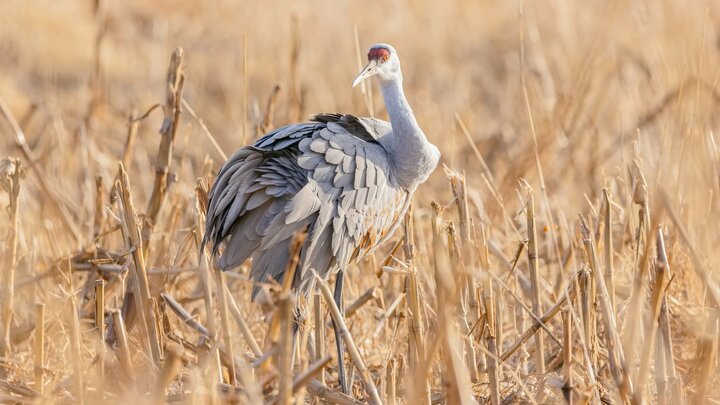
Other private, nonprofit conservation initiatives also depend on ecotourism revenues. The central Platte River complex of Rowe Sanctuary (Audubon) and The Crane Trust are crucial leaders in maintaining and improving habitat for the sandhill cranes (and the few remaining whooping cranes). The sandhill cranes over-winter along the southern U.S. border and breed in northern Canada and Alaska; in spring they stop to refuel along this short stretch of the Platte, staying from early March to early April.
As many as 500,000 to 600,000 migrating cranes spend their days in the surrounding fields and their nights roosting in the river. Jane Goodall called their migration “one of the seven wonders of the natural world.” Both Rowe Sanctuary and the Crane Trust maintain riverine habitat for cranes and other birds, and they depend to a significant degree on revenues from visitors coming to see this ancient and marvelous migration.
In a different way, the success of conservation efforts in South Dakota’s Conata Basin depend on the greater awareness that ecotourism can create. It was the site of a long, highly-publicized, and controversial struggle for proper stewardship of public lands, as private holders of grazing leases attempted to pressure state and federal officials to poison prairie dogs and ban restoration of wildlife, especially black-footed ferrets. T he central issue was whether public lands would be managed only for the benefit of nearby ranchers, or whether there remained a public interest in public lands. Again, awareness of the basin’s biodiversity history and potential was in part heightened by ecotourism.
Thus ecotourism may be a way to bring new revenue streams to private (either for-profit or nonprofit) landowners, helping them pay land taxes and financing efforts to preserve and restore biodiversity. It creates greater awareness of the importance of conservation on private lands. Its success creates economic vitality in surrounding communities, as successful ecotourism enterprises generate demand for all kinds of local services, from guides and catering to equipment purchase and repair to legal, insurance, and financial services.
On public lands as well, ecotourism can help sustain conservation. Monies spent by ecotourists for entrance fees, campsite rentals, hiking guides and other services directly contribute to park revenues. But more importantly, ecotourism builds public and political support to maintain, support, finance and develop public lands. This is true for our underfinanced and often neglected national and state parks, but it is true in spades for other public lands – the national grasslands, national wildlife refuges, state wildlife areas, national scenic rivers, and others. Here, lack of awareness or experience of these lands makes them highly vulnerable to commercial intrusions, private appropriation, neglect and even loss of lands.
Of the Top 10 Sites in the Great Plains, five are national lands – Badlands National Park, Charles M. Russell National Wildlife Refuge, Theodore Roosevelt National Park, Devils Tower National Monument, and Upper Missouri River Breaks National Monument – and one is a state park – Ft. Robinson State Park, in Nebraska. These critical habitats are vulnerable to differing kinds of threats, from demands to open them for energy exploration to pressure for additional road-building to business exploitation to simple under-financing. More ecotourism can promote greater awareness of the natural splendor of these lands, of their precious and precarious status, and of the need to have public officials at all levels aware of the high priority of saving them.
Thus the Center’s initiative in identifying the Top Ecotourism Sites is, at one level, simply to promote greater awareness of the natural grandeur that is the Great Plains. But we have a deeper aim as well, to mobilize greater efforts to conserve, sustain, and pass along to future generations this marvelous, biodiversity-packed environment that we have long taken for granted.


